Bonacieux
The Three MusketeersBonacieux is a Parisian citizen and tradesman whose personal misfortune becomes one of the first decisive openings into the novel’s political conspiracy. His wife, a seamstress to the queen and a goddaughter and protégée of Monsieur Laporte, is abducted while leaving her workroom. Bonacieux therefore appears not as a heroic conspirator but as a frightened, dependent man whose domestic life has been seized by forces far above his social position. Through him, d’Artagnan discovers that the disappearance of Madame Bonacieux is connected to the queen, the cardinal, and the dangerous possibility of an encounter between the queen and the Duke of Buckingham.
Identity and Domestic Position
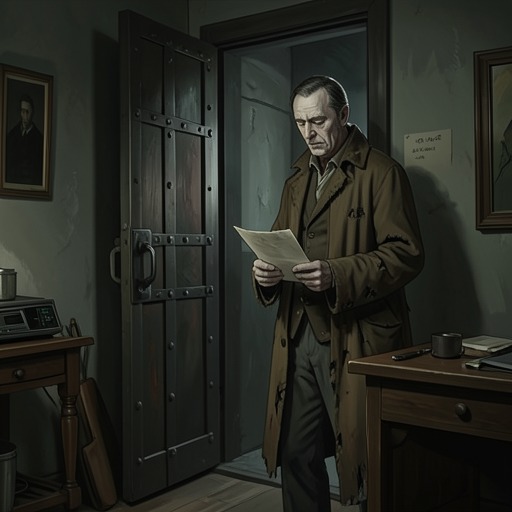
Bonacieux presents himself as an ordinary citizen with a simple, tradesmanlike appearance. His marriage to Madame Bonacieux was contracted about three years before the events of the novel. She brought little dowry, but her connection to Monsieur Laporte, the queen’s cloak bearer, made the match attractive and gave the marriage an indirect link to the royal household. That connection, apparently a private advantage, becomes the source of Bonacieux’s danger when his wife is taken.
His relation to d’Artagnan is both domestic and unequal: he is the young Musketeer’s landlord, and d’Artagnan has occupied the lodging for three months without paying the rent. Bonacieux has refrained from pressing the debt, presenting this forbearance as delicacy and hoping that d’Artagnan will recognize the favor. The detail places him within the precarious economy of ordinary Parisian life, where unpaid rent, dependence on powerful patrons, and fear of official authority coexist. His practical claim as landlord is quickly overshadowed by his appeal for protection.
The Abduction and Appeal to d’Artagnan
Bonacieux arrives at d’Artagnan’s lodging in the guise of a tradesman and insists that his information is important and confidential. He asks to speak privately, prompting d’Artagnan to dismiss Planchet. Bonacieux declares that he has heard of d’Artagnan’s reputation as a brave young man and has decided to entrust him with a secret. His appeal is calculated less as a political argument than as an attempt to borrow another man’s courage.
The secret is that Madame Bonacieux was abducted the previous morning as she came out of her workroom. Bonacieux is not merely reporting a crime; he is seeking a rescuer because he does not possess the physical or institutional power to recover her himself. The abduction turns the household into a contested space. His wife’s employment near the queen places the marriage at the edge of court politics, while his own ordinary status leaves him exposed to arrest, interrogation, and intimidation.
Bonacieux repeatedly admits that he is afraid. He is not a fighting man, and the threat of the Bastille terrifies him. When he swears by his own name in an effort to recover his courage, d’Artagnan recognizes the name and discovers that the visitor is his landlord. The revelation shifts the scene from a mysterious confidential interview into a collision of obligation: d’Artagnan owes Bonacieux rent, while Bonacieux asks him to risk his life for Madame Bonacieux. The landlord’s financial grievance is thus absorbed into a much larger crisis.
Political Entanglement and Surveillance
Bonacieux believes that d’Artagnan’s association with the Musketeers gives him access to men capable of resisting the cardinal’s authority. Seeing d’Artagnan constantly surrounded by the splendid Musketeers of Monsieur de Treville, and knowing that they are enemies of the cardinal, he hopes that d’Artagnan and his companions will do the queen justice and inflict a setback on Cardinal Richelieu. His understanding is partial but important: he sees the political alignment without mastering its full consequences.
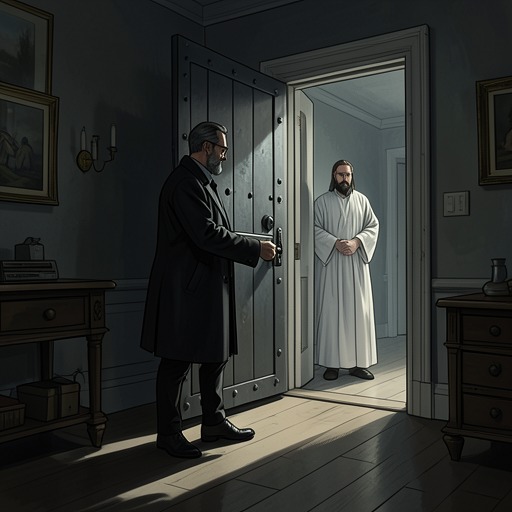
The authorities transform Bonacieux’s apartment into a mousetrap, a secret arrest system in which suspected premises are watched and visitors are admitted only to be seized and interrogated. Cardinal’s agents use the residence to collect information about anyone connected with Bonacieux or his wife. The mechanism converts a private home into an instrument of policing. Bonacieux’s domestic space no longer protects him; it becomes a trap for his acquaintances and a node in the cardinal’s information network.
D’Artagnan avoids the trap because a separate passage leads to his upper lodging. He remains in his room, turning it into an observatory from which he watches visitors being captured. After removing a plank from the floor, he listens to the interrogations taking place below. The repeated questions concern whether Madame Bonacieux has sent anything to her husband or anyone else, whether Bonacieux has sent anything to her, and whether either spouse has revealed information by word of mouth. These questions expose what the authorities truly fear: the possibility that the Duke of Buckingham is in Paris and may meet the queen.
Bonacieux is consequently more than a frightened husband. His name and house become the visible surface of a hidden communications system linking the queen’s service, d’Artagnan, Buckingham, and the cardinal’s police. The state’s surveillance of him demonstrates how quickly an apparently insignificant citizen can become politically dangerous when his family connection intersects with royal secrecy.
Narrative Function and Significance
Bonacieux occupies an intermediate position between the ordinary social world and the aristocratic world of conspiracy. He is neither an effective agent of the queen nor a deliberate servant of the cardinal. His value to the plot lies in precisely this weakness: because he is close enough to the relevant household to possess a clue, yet powerless enough to need outside help, his distress brings d’Artagnan across the threshold into the novel’s larger adventure.
His fear also provides a sharp contrast with d’Artagnan’s appetite for risk. Where Bonacieux sees the Bastille and imagines imprisonment, d’Artagnan sees danger as an opportunity for action and advancement. The landlord’s appeal therefore activates d’Artagnan’s courage, ambition, and instinct for advantageous service at once. Bonacieux’s vulnerability supplies the immediate human cause for a chain of actions whose consequences reach the queen, Buckingham, Richelieu, and the political future of France.
The broader crisis surrounding Bonacieux unfolds against the struggle over La Rochelle. Cardinal Richelieu seeks to destroy the last major bulwark of Calvinism, whose political and foreign connections threaten royal authority; the city’s port is also the last in France open to the English. Buckingham’s arrival near the Isle of Ré with ninety vessels and nearly twenty thousand men turns the conflict into an international military confrontation. Later, hunger reduces La Rochelle to desperate appeals for Buckingham’s relief, while disease, poor food, rough seas, and wrecked vessels weaken the English camp. Bonacieux’s domestic emergency thus belongs to the same political world in which private attachments and military resources are repeatedly entangled.
Bonacieux remains memorable because the novel makes political history enter through an unpaid rent, a missing wife, and a frightened citizen’s request for help. His limited courage does not make him irrelevant; it makes him structurally necessary. The surveillance of his apartment, the questions put to his visitors, and d’Artagnan’s secret observation from above convert his personal household into a miniature model of the entire book: power operates through doors, intermediaries, secrets, and arrests, while loyalty must move through the narrow spaces left open by fear.